

Le mot « superaliment » est tellement galvaudé qu'il en est presque dénué de sens. La plupart des aliments qualifiés de « super » sont simplement des plantes denses sur le plan nutritionnel — utiles, mais pas magiques. Le moringa en est un excellent exemple. Voici une perspective plus honnête sur ce qu'il est et où il se situe.
La vraie définition de « superaliment »
« Superaliment » est un terme marketing, non une catégorie scientifique. Il décrit généralement un aliment végétal dense sur le plan nutritionnel par rapport à sa teneur en calories. Les épinards, le chou frisé, les bleuets, les noix et, oui, le moringa, sont couramment cités.
L'étiquette est surtout utile comme raccourci. La vraie valeur réside dans la consommation d'une alimentation variée d'aliments entiers, principalement d'origine végétale — et non dans la quête d'un seul ingrédient « super ».
Ce que le moringa apporte réellement
Les feuilles de moringa sont naturellement une source de :
- Fibres végétales et protéines végétales modestes
- Minéraux comme le fer, le calcium, le magnésium et le potassium
- Vitamines A, C et E en quantités modestes
- Composés végétaux (polyphénols, antioxydants) courants dans les légumes verts à feuilles
Les valeurs exactes varient d'un lot à l'autre. Notez que le moringa n'est pas une source fiable de vitamine B12, malgré certaines affirmations en ligne.
Pourquoi il mérite sa place
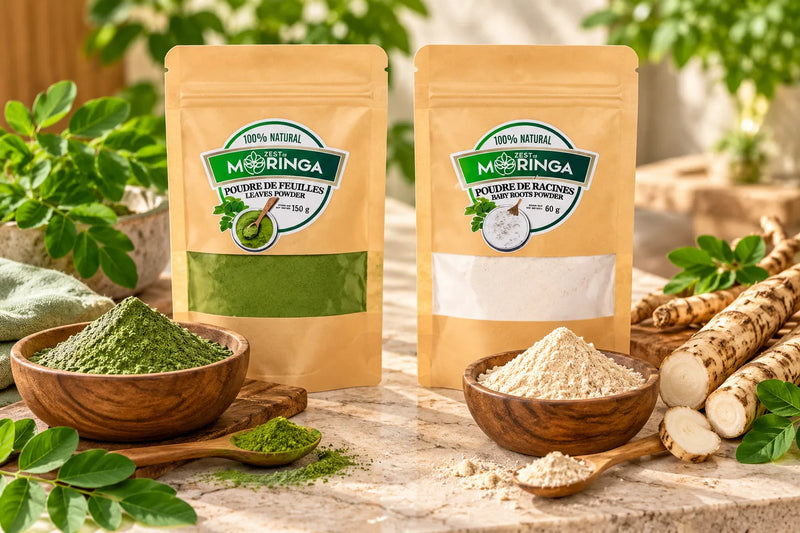
Le moringa est un ingrédient végétal utile et facile à ajouter. Une cuillère à café de poudre de feuilles dans votre smoothie, une tasse de thé de feuilles sans caféine l'après-midi, ou 1 à 2 capsules végétaliennes au petit-déjeuner s'intègrent tous à une routine régulière sans trop de complications.
Ce qu'il ne fera pas
- Il ne remplacera pas une alimentation équilibrée.
- Il ne guérira aucune maladie.
- Il ne remplacera pas le sommeil, l'hydratation ou l'activité physique.
- Il n'offrira pas de transformations spectaculaires à ingrédient unique.
Le cadre sensé
Le moringa est l'un des nombreux ingrédients végétaux utiles. Utilisez-le comme un élément d'une routine variée et axée sur les plantes. Ne pariez pas votre bien-être sur un seul ingrédient « super ».
Consultez un professionnel de la santé avant d'ajouter de nouvelles herbes à votre routine.
0 Comments