

Les feuilles de Moringa oleifera sont utilisées comme ingrédient alimentaire dans les cuisines tropicales depuis des siècles. L'intérêt moderne pour le moringa en tant que « superaliment » vient de sa densité nutritionnelle – la feuille concentre une variété notable de nutriments dans une petite portion.
La Réponse Courte
La feuille de moringa est naturellement une source de :
- Fibres végétales — soutient la digestion dans le cadre d'une alimentation variée.
- Protéines végétales — modeste mais notable pour un légume-feuille.
- Minéraux — fer, calcium, magnésium et potassium.
- Vitamines — A, C et E en quantités modestes.
- Composés végétaux — y compris divers polyphénols et antioxydants naturellement présents dans les feuilles vertes.
La Portion Standard
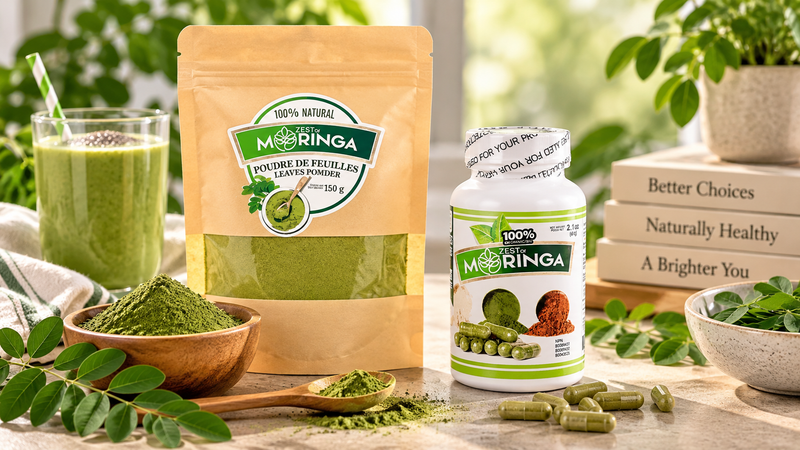
Une cuillère à café de poudre de feuilles de moringa représente environ 1,5 g de feuilles séchées. C'est la portion quotidienne typique que la plupart des gens utilisent, souvent répartie sur deux repas ou prise dans un seul smoothie.
Comment les Valeurs Nutritionnelles Varient
Les valeurs spécifiques dépendent des conditions de croissance, de la méthode de séchage et de la période de récolte des feuilles. La poudre moulue sur pierre, séchée à basse température, conserve généralement plus de composés végétaux originaux que les alternatives industrielles traitées thermiquement.
Comment Tirer le Meilleur Parti de Votre Portion
- Ajoutez aux boissons froides ou tièdes — évitez une ébullition prolongée, qui atténue les composés végétaux naturels.
- Associez à une alimentation variée — le moringa est un ingrédient, pas un substitut à une alimentation à base d'aliments entiers.
- Conservez le sachet dans un endroit frais, sec et sombre, à l'abri de la chaleur et de l'humidité.
Les informations contenues dans cet article sont de nature générale et ne remplacent pas les conseils personnalisés d'un diététiste professionnel ou d'un professionnel de la santé.

0 Comments