

Marula and moringa are two great oleic oils of warm climates: marula grows in southern Africa, moringa is native to the foothills of the Himalayas, yet both are about three quarters oleic acid and both are sold as premium face oils. Of all the comparisons in our series, this is the closest match. The differences are subtle, but they are real.
This guide compares cold-pressed moringa oil and marula oil using published analyses and skin studies, and says plainly where marula holds its own.
Quick Answer
- Choose moringa oil if you want behenic acid, documented vitamin E and published oxidation data, plus a hydration study against an identical base cream.
- Choose marula oil if you value a slightly larger body of small skin tests, including measurements of water loss.
- Both suit dry and mature skin, and both have a rich, cushioning feel.
Moringa Oil vs Marula Oil: Side-by-Side
| Compared on | Moringa oil (cold-pressed) | Marula oil |
|---|---|---|
| Oleic acid (omega-9) | 72 to 78% | 69 to 78% |
| Linoleic acid (omega-6) | About 1 to 4% | 3 to 9% |
| Behenic acid | 3.7 to 6.7% | Not reported |
| Palmitoleic acid (omega-7) | Trace | About 4% |
| Vitamin E (total tocopherols) | About 200 to 280 mg/kg | Not verified in published data |
| Resistance to rancidity | 8 to 34 h at 120 °C (Rancimat) | Very stable: little change after 24 months at 30 °C |
| Human skin studies | +85% hydration vs +48% for the same cream without it (32 people, 4 weeks) | Four small tests (20 women each): non-irritating, hydrating, reduced water loss |
| Feel on skin | Rich, cushioning | Rich, cushioning |
Values vary with origin and processing. Sources are listed at the end of this article.
How Moringa Compares With Other Popular Face Oils
Marula is a close cousin. Here is how cold-pressed moringa oil compares with the five face oils people ask us about most, on the same criteria.
| Compared on | Moringa (cold-pressed) | Argan | Jojoba | Rosehip | Grapeseed | Olive |
|---|---|---|---|---|---|---|
| Behenic acidA rare fatty acid, named after ben (moringa) oil | 3.7 to 6.7%Moringa leads | Not reported | Not reported | Not reported | 0.5% max | 0.3% max |
| Oleic acid (omega-9)The nourishing, skin-softening fatty acid | 72 to 78%Moringa leads | 41 to 55% | Liquid wax, about 14% | 15 to 22% | 12 to 28% | 55 to 83% |
| Resistance to rancidityLab oxidation test (Rancimat) | 34 h at 120 °CMoringa leads | More fragile: 27 to 37% omega-6 | 9.5 h at 130 °C | 3.5 h at 110 °C | 4.1 h at 110 °C | 7.9 h at 120 °C |
| Vitamin ETotal tocopherols, mg/kg | 200 to 280 | 324 to 792 | Not verified | 786 | 140 to 410 | About 100 |
| Human skin studyPublished, topical use | +85% hydration (32 people, 4 weeks) | Elasticity (60 women, 60 days) | Hydration (32 people, 2 weeks) | Limited data | Not yet studied on skin | Mixed results |
Values vary with origin and processing. Oxidation tests run at different temperatures are not directly comparable. Sources: Tsaknis 1999; Anwar 2006; Athikomkulchai 2021; Azizi 2022; Zaanoun 2014; Codex Standard 210-1999; Kiralan 2019; Grasas y Aceites 2018; Boucetta 2015; Vaughn et al.
Two Oleic Oils, Two Different Signatures
Both oils are built on oleic acid, the softening omega-9 fatty acid, and both contain very little polyunsaturated fat. That is why they feel similar and why both resist going rancid. Each has a fatty acid the other lacks:
- Moringa oil contains 3.7 to 6.7% behenic acid, a long-chain fatty acid named after ben oil, the historic name of moringa oil. It is one of very few plant oils with a meaningful amount.
- Marula oil contains about 4% palmitoleic acid (omega-7), a fatty acid that is uncommon in plant oils.
Where Moringa Oil Comes Out Ahead
1. Behenic acid
Marula analyses do not report behenic acid. Moringa oil is one of the richest plant sources, which gives it its characteristic cushioning finish.
2. Documented vitamin E
Cold-pressed moringa oil contains about 200 to 280 mg/kg of tocopherols, with an unusually high share of delta-tocopherol. We could not find reliable published figures for marula oil, so we only claim what is documented.
3. Hard numbers on stability
In a laboratory oxidation test at 120 °C, cold-pressed moringa oil lasted 34 hours before oxidizing, about four times longer than virgin olive oil in the same test (Tsaknis et al., 1999); other studies report 8 to 10 hours at the same temperature. Marula is also very stable: its quality changed only slightly after 24 months of dark storage at 30 °C (Mariod et al., 2008). Both keep well; moringa simply has more precise published measurements.
4. A hydration result against an identical base
In a 4-week study on 32 volunteers, a cream with 25% moringa seed oil raised skin hydration by 85%, versus 48% for the identical cream without it, with no irritation (Athikomkulchai et al., 2021). Comparing the same cream with and without the oil isolates the oil's own effect.
Where Marula Oil Comes Out Ahead
1. More skin tests
Marula oil was assessed in four small clinical tests of 20 women each (Komane et al., 2016). It was non-irritating, hydrated dry skin, formed an occlusive layer and moderately reduced water loss from the skin. Moringa oil's barrier effect has not been measured, so on this point marula has more data.
2. Palmitoleic acid
Marula's omega-7 content is a genuine point of difference, even if its specific effect on skin is not well studied.
Which One Is Better for Your Skin Type?
- Dry or mature skin: both work well. Choose moringa oil for behenic acid and documented vitamin E.
- Very dry, winter-stressed skin: either oil over a moisturizer, at night.
- Oily or breakout-prone skin: neither is the first choice; one or two drops at night is enough.
- Sensitive skin: both were non-irritating in their studies. With any new oil, test a small area first.
Can You Use Moringa Oil and Marula Oil Together?
Yes. Their profiles are similar, so mixing them changes the feel very little. Because both are stable, a small blend keeps well. Many people simply choose one and use it consistently.
How to Use Moringa Oil on Your Face
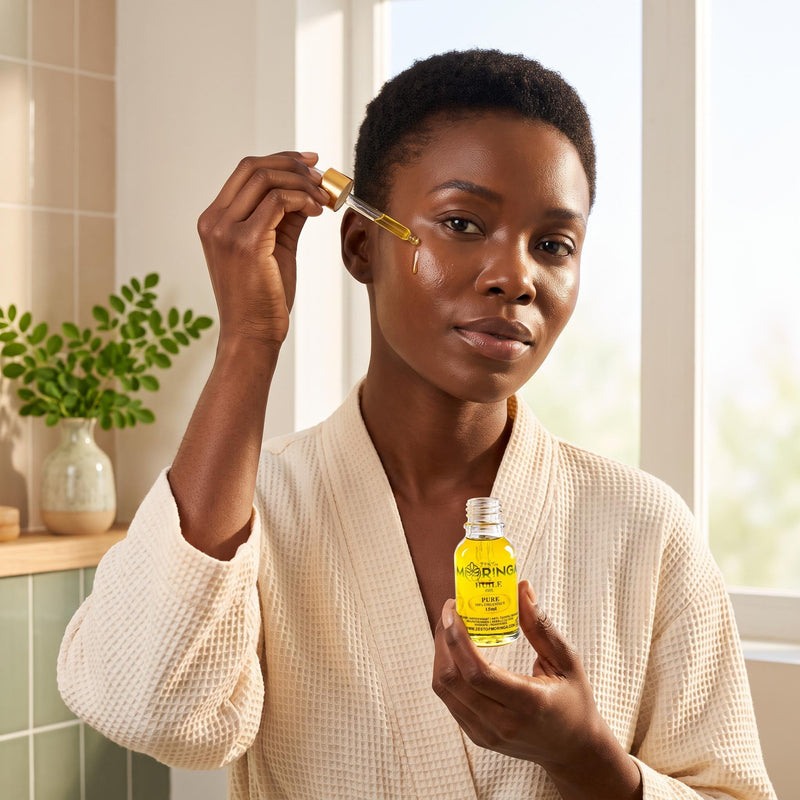
- Cleanse and apply your usual water-based serum or moisturizer.
- Warm 2 to 3 drops of moringa oil between your fingertips.
- Press gently onto the face and neck rather than rubbing.
- Use it at night, or in the morning under sunscreen if your skin is dry.
Pure moringa oil can turn cloudy or partly solid in the cold. This is normal, and it becomes clear again at room temperature.
Frequently Asked Questions
Is moringa oil better than marula oil?
They are close. Moringa oil offers behenic acid, documented vitamin E, precise oxidation data and a hydration study against an identical base cream. Marula oil has more small skin tests, including reduced water loss. For dry or mature skin, both are excellent choices.
Are moringa oil and marula oil similar?
Yes. Both are about 70 to 78% oleic acid and low in polyunsaturated fat. Moringa adds behenic acid; marula adds palmitoleic acid.
Which oil lasts longer?
Both are very stable. Moringa oil has precise laboratory oxidation data showing high stability, and marula oil changed only slightly after two years of storage.
Does marula oil have more vitamin E than moringa oil?
We could not find reliable published figures for marula oil. Cold-pressed moringa oil contains about 200 to 280 mg/kg.
Can I use moringa oil on my hair like marula oil?
Yes. Both work as conditioning oils on lengths and ends. Start with one or two drops, especially on fine hair.
The Bottom Line
Marula and moringa are close cousins, and both are excellent for dry and mature skin. Marula has a few more small skin tests. Moringa oil brings what marula does not: behenic acid, documented vitamin E, precise stability data and a controlled hydration result. If those points matter to you, moringa oil is the better fit.
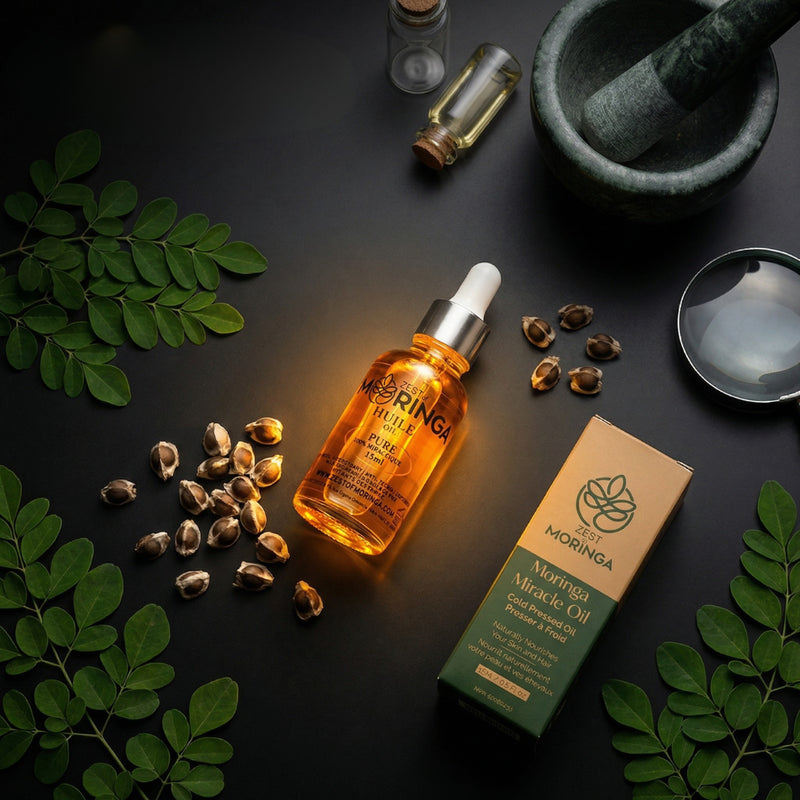
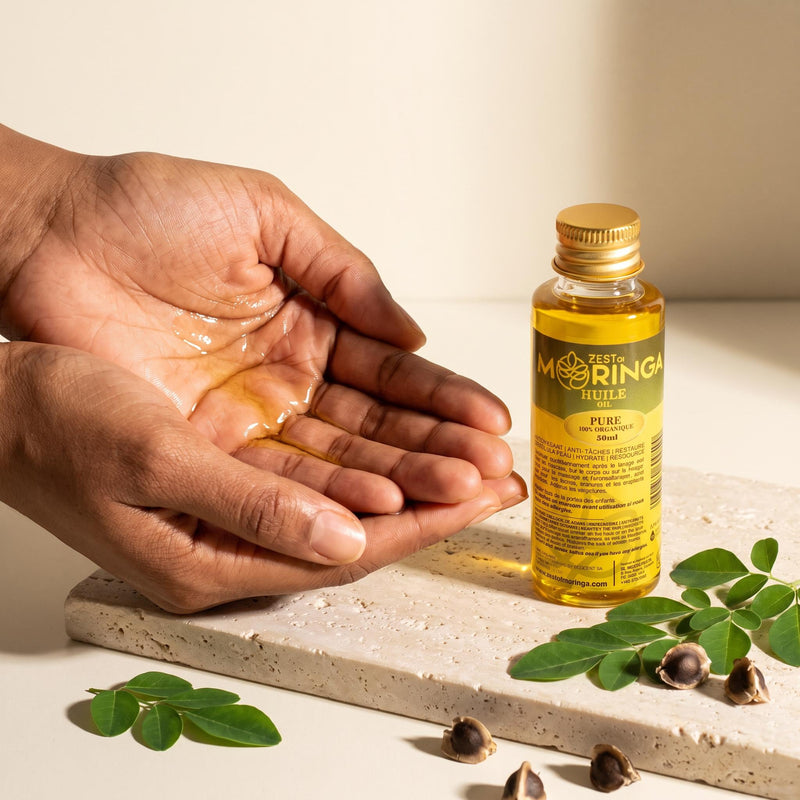
Our Moringa Golden Face Oil is a single-ingredient, cold-pressed moringa seed oil, available in five sizes. Read the rest of our series: vs Argan, vs Jojoba, vs Rosehip and vs Olive Oil, or browse the skin and hair care collection.
Sources
- Tsaknis J. et al. (1999). Characterization of Moringa oleifera variety Mbololo seed oil of Kenya. Journal of Agricultural and Food Chemistry, 47, 4495 to 4499.
- Anwar F. et al. (2006). Physico-chemical characteristics of Moringa oleifera seeds and seed oil from a wild provenance of Pakistan. Grasas y Aceites, 57(2).
- Athikomkulchai S. et al. (2021). Moringa oleifera seed oil formulation physical stability and chemical constituents for enhancing skin hydration and antioxidant activity. Cosmetics, 8(1), 2.
- Komane B. et al. (2016). Safety and efficacy of Sclerocarya birrea (marula) oil: a clinical perspective. Journal of Ethnopharmacology, 176, 327 to 335.
- Mariod A.A. et al. (2008). Oxidative stability of marula oil during storage. Grasas y Aceites, 59(1).
Cosmetic product. This article is for general information and is not intended to diagnose, treat or prevent any condition.
0 Comments