

Jojoba is often called the face oil that is "closest to your skin". Moringa oil, the historic ben oil, is known for staying fresh and for a fatty acid you rarely find elsewhere. They are often compared, but they are not even the same kind of ingredient: jojoba is a liquid wax, while moringa is a true plant oil.
This guide compares the two using published analyses and skin studies, and is honest about where jojoba is the better choice.
Quick Answer
- Choose moringa oil if your skin is dry or mature and you want a richer, cushioning oil with behenic acid and a published hydration study.
- Choose jojoba if your skin is oily or prone to breakouts and you want a very light, gliding texture.
- Both are among the most oxidation-resistant ingredients you can put on your face, so both keep well once opened.
Moringa Oil vs Jojoba Oil: Side-by-Side
| Compared on | Moringa oil (cold-pressed) | Jojoba (golden) |
|---|---|---|
| What it is | A true plant oil (triglycerides) | A liquid wax (about 98% wax esters) |
| Main fatty acid | Oleic acid, 72 to 78% | Eicosenoic acid, about 70% |
| Behenic acid | 3.7 to 6.7% | Not reported |
| Vitamin E (total tocopherols) | About 200 to 280 mg/kg | Not verified in published data |
| Resistance to rancidity | Very high: 34 h at 120 °C | Very high: 9.5 h at 130 °C |
| Comedogenic rating | No published test | 0 to 2 (Fulton, 1989) |
| Human skin study | +85% hydration vs +48% for the same cream without it (32 people, 4 weeks) | Hydration rose, but no better than almond, coconut or petrolatum (32 people, 2 weeks) |
| Feel on skin | Rich, cushioning | Very light, gliding |
Values vary with origin and processing. The two oxidation tests were run at different temperatures, so the hours are not directly comparable: both oils are very stable. Sources are listed at the end of this article.
How Moringa Compares With Other Popular Face Oils
Jojoba is only one option. Here is how cold-pressed moringa oil compares with the five face oils people ask us about most, on the same criteria.
| Compared on | Moringa (cold-pressed) | Argan | Jojoba | Rosehip | Grapeseed | Olive |
|---|---|---|---|---|---|---|
| Behenic acidA rare fatty acid, named after ben (moringa) oil | 3.7 to 6.7%Moringa leads | Not reported | Not reported | Not reported | 0.5% max | 0.3% max |
| Oleic acid (omega-9)The nourishing, skin-softening fatty acid | 72 to 78%Moringa leads | 41 to 55% | Liquid wax, about 14% | 15 to 22% | 12 to 28% | 55 to 83% |
| Resistance to rancidityLab oxidation test (Rancimat) | 34 h at 120 °CMoringa leads | More fragile: 27 to 37% omega-6 | 9.5 h at 130 °C | 3.5 h at 110 °C | 4.1 h at 110 °C | 7.9 h at 120 °C |
| Vitamin ETotal tocopherols, mg/kg | 200 to 280 | 324 to 792 | Not verified | 786 | 140 to 410 | About 100 |
| Human skin studyPublished, topical use | +85% hydration (32 people, 4 weeks) | Elasticity (60 women, 60 days) | Hydration (32 people, 2 weeks) | Limited data | Not yet studied on skin | Mixed results |
Values vary with origin and processing. Oxidation tests run at different temperatures are not directly comparable. Sources: Tsaknis 1999; Anwar 2006; Athikomkulchai 2021; Azizi 2022; Zaanoun 2014; Codex Standard 210-1999; Kiralan 2019; Grasas y Aceites 2018; Boucetta 2015; Vaughn et al.
Oil vs Wax: The Difference That Matters
Most face oils, including moringa, argan and rosehip, are made of triglycerides: three fatty acids attached to a glycerol backbone. Glycerides and the fatty acids they release are also the largest family of lipids in your skin's natural sebum.
Jojoba is different. About 98% of it is made of wax esters, long chains made of a fatty acid joined to a fatty alcohol. That is why jojoba feels so light and dry-touch, and why it stays liquid at room temperature but turns solid around 7 °C.
Moringa oil gives your skin a high dose of oleic acid (72 to 78%), the softening fatty acid, plus 3.7 to 6.7% behenic acid. Jojoba gives you a protective, non-greasy wax film.
"Jojoba Is Identical to Sebum": True or False?
It is a popular claim, but it is not accurate. Human sebum is roughly 26% wax esters, 12% squalene and about 57% glycerides and free fatty acids. Jojoba resembles only the wax ester part, about a quarter of sebum. A fair way to say it: jojoba is chemically similar to the wax esters in sebum, not identical to sebum.
Moringa oil, being a triglyceride oil, resembles a different part of sebum: the glyceride fraction. Neither ingredient "is" sebum.
Where Moringa Oil Comes Out Ahead
1. A direct, controlled hydration result
In a 4-week study on 32 volunteers, a cream with 25% moringa seed oil raised skin hydration by 85%, versus 48% for the identical cream without moringa oil (Athikomkulchai et al., 2021). The comparison against the same base is what makes this result meaningful. No participant showed irritation.
In the jojoba study (Vaughn et al.), skin hydration also increased over 2 weeks, but jojoba performed no better than almond oil, coconut oil or petrolatum.
2. Behenic acid and oleic acid
Moringa oil contains 3.7 to 6.7% behenic acid, a long-chain fatty acid that takes its name from ben oil, and 72 to 78% oleic acid. This combination gives a richer, cushioning finish that dry and mature skin tends to appreciate.
3. Documented vitamin E
Cold-pressed moringa oil contains about 200 to 280 mg/kg of tocopherols, including an unusually high share of delta-tocopherol. We could not find reliable published figures for jojoba, so we do not claim a winner here beyond what is documented.
Where Jojoba Comes Out Ahead
1. A lighter texture
Jojoba glides on with very little friction and leaves a dry-touch finish. If you dislike any feeling of oil on your face, jojoba is easier to wear during the day.
2. A published comedogenic rating
In the reference work on comedogenicity (Fulton, 1989), jojoba was rated 0 to 2 on a 5-point scale, depending on the raw material. Moringa oil has never been tested this way, so we do not claim it is non-comedogenic. If your skin breaks out easily, jojoba has more data behind it.
Both Keep Very Well
Oils go rancid when their polyunsaturated fats oxidize, and both of these ingredients contain very little. Cold-pressed moringa oil lasted 34 hours at 120 °C in a laboratory oxidation test, about four times longer than virgin olive oil in the same test (Tsaknis et al., 1999). Jojoba measured 9.5 hours at 130 °C, a higher temperature that shortens results. The fair conclusion: both are far more stable than rosehip or grapeseed oil, and both stay fresh from the first drop to the last.
Which One Is Better for Your Skin Type?
- Dry, mature or winter-dry skin: moringa oil, for its richer feel and its controlled hydration result.
- Oily or breakout-prone skin: jojoba, for its light texture and its published comedogenic rating.
- Combination skin: moringa oil at night on dry areas, jojoba in the morning, or one drop of each mixed in your palm.
- Sensitive skin: no participant reacted in the moringa study. With any new product, test a small area first.
Can You Mix Moringa Oil and Jojoba?
Yes, and they work well together. Jojoba lightens the texture, while moringa oil adds oleic and behenic acids. Because both resist oxidation, a small homemade blend keeps well. Mix only what you will use within a few weeks and store it away from light.
How to Use Moringa Oil on Your Face
- Cleanse and apply your usual water-based serum or moisturizer.
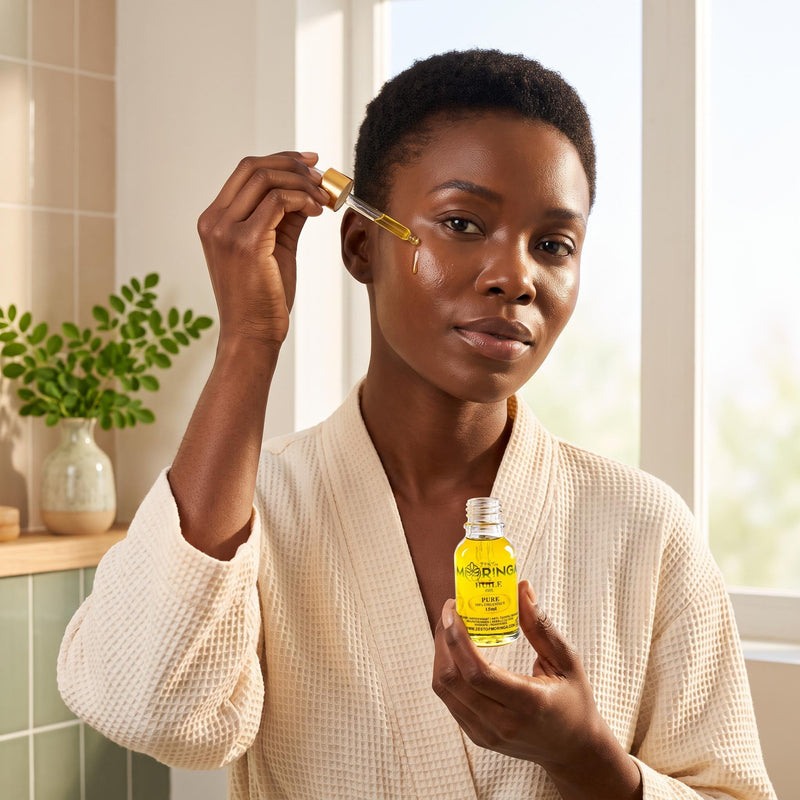
- Warm 2 to 3 drops of moringa oil between your fingertips.
- Press gently onto the face and neck rather than rubbing.
- Use it at night, or in the morning under sunscreen if your skin is dry.
Like jojoba, pure moringa oil can turn cloudy or partly solid in the cold. This is normal, and it becomes clear again at room temperature.
Frequently Asked Questions
Is moringa oil better than jojoba oil?
For dry or mature skin, moringa oil is usually the better fit: it is richer, contains behenic acid and has a controlled hydration study. For oily or breakout-prone skin, jojoba is lighter and has a published comedogenic rating.
Is jojoba oil really an oil?
Not technically. About 98% of jojoba is made of liquid wax esters, while moringa oil is a true plant oil made of triglycerides.
Is jojoba identical to human sebum?
No. Jojoba resembles the wax ester part of sebum, which is only about a quarter of it. Sebum also contains squalene and a large share of glycerides and free fatty acids.
Which lasts longer once opened?
Both are very stable. In published oxidation tests, both resisted rancidity far longer than common plant oils like rosehip, grapeseed or olive.
Is moringa oil non-comedogenic?
Moringa oil has never been given a comedogenic rating in a published test, so we do not make that claim. If you are prone to breakouts, start with one or two drops at night and see how your skin responds.
The Bottom Line
Jojoba is an excellent lightweight choice for oily skin. Moringa oil is the better pick when your skin needs comfort and nourishment: it delivers oleic and behenic acids, it is one of the most oxidation-resistant oils available, and it is backed by a controlled hydration study. For dry, mature or winter-stressed skin, moringa oil is the stronger fit.
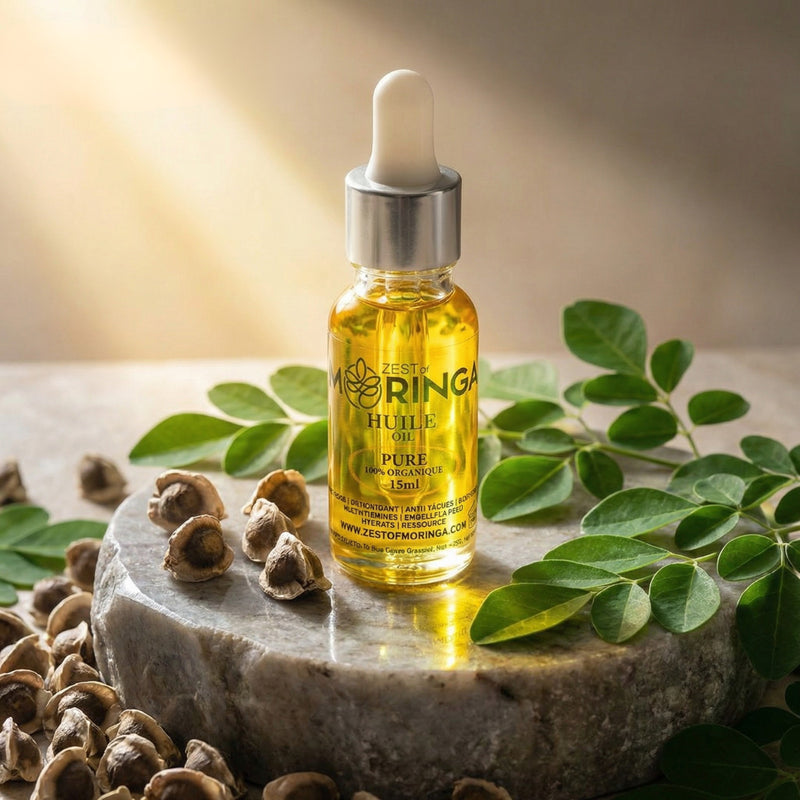
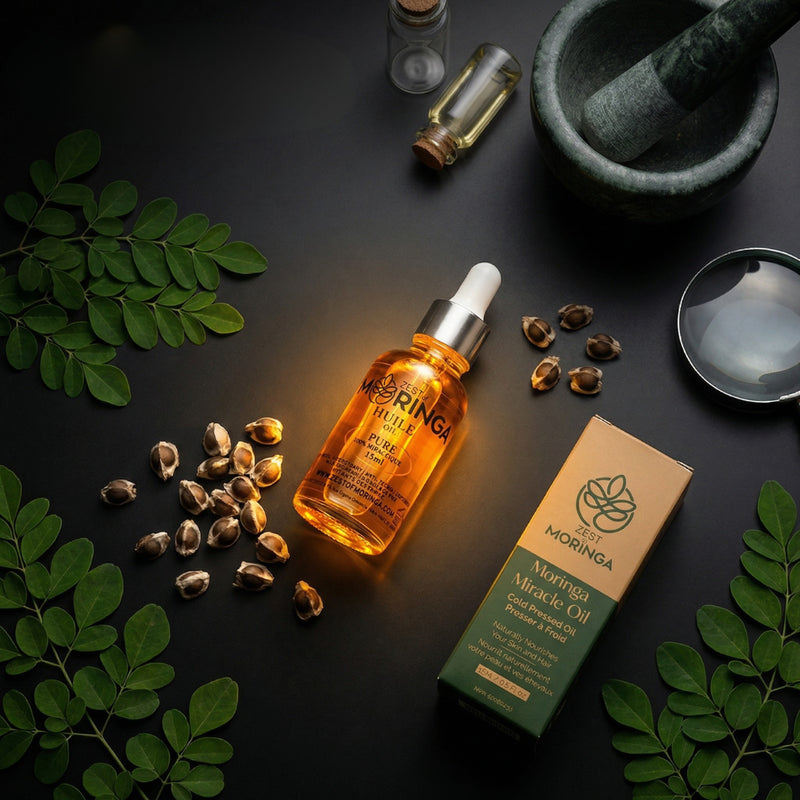
Our Moringa Golden Face Oil is a single-ingredient, cold-pressed moringa seed oil, available in five sizes. Read also Moringa Oil vs Argan Oil, our guide to using moringa oil on your face, and browse the skin and hair care collection.
Sources
- Tsaknis J. et al. (1999). Characterization of Moringa oleifera variety Mbololo seed oil of Kenya. Journal of Agricultural and Food Chemistry, 47, 4495 to 4499.
- Anwar F. et al. (2006). Physico-chemical characteristics of Moringa oleifera seeds and seed oil from a wild provenance of Pakistan. Grasas y Aceites, 57(2).
- Athikomkulchai S. et al. (2021). Moringa oleifera seed oil formulation physical stability and chemical constituents for enhancing skin hydration and antioxidant activity. Cosmetics, 8(1), 2.
- Fulton J.E. (1989). Comedogenicity and irritancy of commonly used ingredients in skin care products. Journal of the Society of Cosmetic Chemists, 40(6), 321 to 333.
- Vaughn A.R. et al. Comparison of natural oils and petrolatum on skin hydration and barrier function: a randomized pilot study. Journal of Skin (ClinicalTrials.gov NCT03093597).
- Elementis Specialties (2011). Technical comparison of meadowfoam seed oil and jojoba oil (wax ester composition, oxidative stability index).
- Agache P. (2004). Sebaceous physiology, in Measuring the Skin. Springer (sebum composition).
Cosmetic product. This article is for general information and is not intended to diagnose, treat or prevent any condition.
0 Comments