How to Tell If Moringa Oil (Ben Oil) Is Good Quality: Colour, Clarity and the Bottle
Home› News› How to Tell If Moringa Oil (Ben Oil) ...
Ben Oil

How to Tell If Moringa Oil (Ben Oil) Is Good Quality: Colour, Clarity and the Bottle

Good moringa oil shows its quality before you open it: a deep golden colour, a clean scent and a single ingredient. Here is a simple checklist, and why the bottle matters.

ZM
by Zest Of Moringa October 30, 2026 2 min read
𝕏 f P @

Moringa oil is pressed from the seeds of Moringa oleifera. Two bottles can carry the same name and still be very different oils. The good news: you can judge most of the difference with your own eyes, as long as the bottle lets you look.

Moringa oil goes by many names: ben oil, behen oil, benzolive oil, drumstick tree oil or malunggay oil. Whatever the label says, the same quality checks apply, and they are the ones below. (Curious about the names? Read all the names of moringa and the history of ben oil.)

1. Look at the colour first

A fresh, cold-pressed moringa oil from the first pressing has a deep, rich golden colour. That colour comes from the seed itself, and it is one of the easiest quality signals to check.

An oil that looks very pale, washed out or almost colourless has usually been refined, heated or pressed a second time. Those steps make an oil cheaper to produce, but they strip away much of what makes moringa oil worth using.

2. Check the clarity, and know what cloudiness means

At room temperature, good moringa oil is clear and bright. In a cold room it can turn slightly cloudy. That is normal: moringa oil naturally contains behenic acid, which sets in the cold and clears again when you warm the bottle in your hands. An oil that stays perfectly clear even near the fridge has often been refined or blended.

3. Read the ingredient list

Pure moringa oil needs one line on the label: Moringa oleifera seed oil. No carrier oils, no fragrance, no fillers. If the list is longer, you are buying a blend.

4. Smell it

Cold-pressed moringa oil has a faint, mild, slightly nutty scent. A strong perfume usually means added fragrance. A sharp or rancid smell means the oil has oxidised.

5. Look at the bottle itself

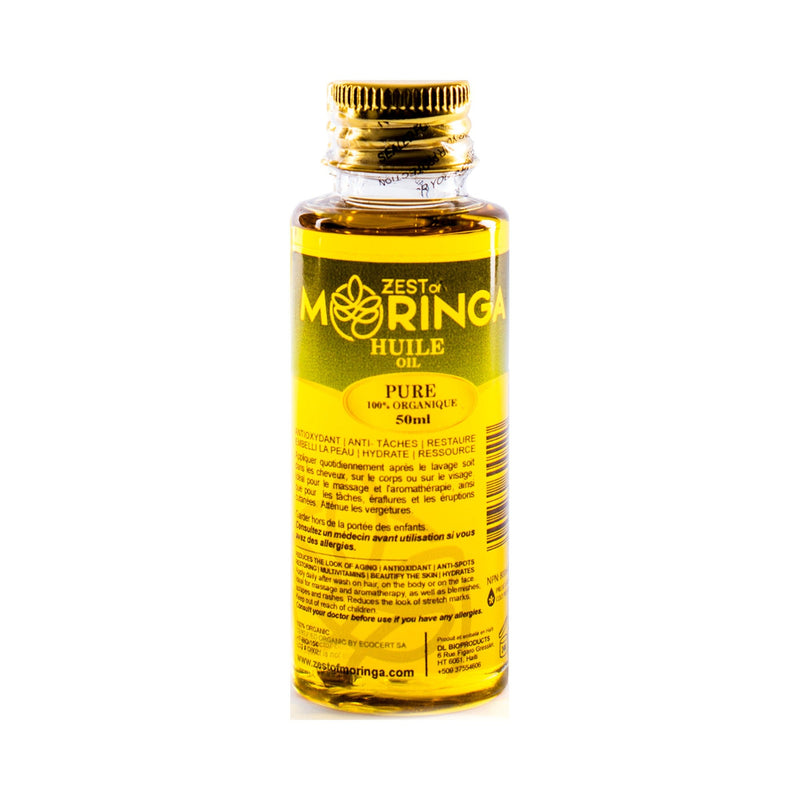
See the gold before you buy: Zest of Moringa clear bottle compared with an opaque bottle

Many brands sell moringa oil in dark or opaque bottles. With an opaque bottle, you cannot check the colour or the clarity until you have paid and opened it. That makes it impossible to tell a first cold press from a refined or second-press oil on the shelf.

We made the opposite choice. Our moringa oil comes in a clear bottle on purpose, so you can hold it up to the light and see the deep gold before you buy. We would rather show the oil than ask you to trust it.

Watch: see the gold in 30 seconds

A clear bottle and storage

Light is what degrades a cold-pressed oil fastest, so a clear bottle comes with one simple habit: keep it closed, in a cool, dark cupboard between uses, ideally between 18 and 22 °C. Stored that way, a sealed bottle keeps around 12 months, and an opened one is best used within about six months.

Quick checklist before you buy moringa oil

  • Colour: deep golden, not pale or colourless
  • Clarity: clear at room temperature, may cloud in the cold
  • Ingredients: one line, Moringa oleifera seed oil
  • Scent: faint and mild, no perfume, nothing sharp
  • Bottle: one that lets you see the oil

See it for yourself

Our Golden Moringa Face Oil is 100% cold-pressed moringa seed oil, one ingredient, in clear bottles from 15 ml to 500 ml. For how to use it, read how to use moringa face oil in a skincare routine.

Zest of Moringa skincare products are cosmetics, not medicines. Patch test before first use.
ZM
Written by

Zest Of Moringa

Editorial team at Zest Of Moringa. Writing about plant-based wellness, single-ingredient moringa, and the rituals that come with it.

✿

Loved this? Subscribe.

Get more stories like this in your inbox once a month: recipes, rituals and new product drops.

0 Comments

Moringa oil vs other face oils

Not all face oils are equal.

How cold-pressed moringa oil compares with the most popular face oils, based on published lab and skin studies.

3.7 to 6.7%

Behenic acid. A rare fatty acid that the most popular face oils barely contain. It is named after ben oil, the historic name of moringa oil.

About 4× longer

Resists going rancid. In the same lab test at 120 °C, cold-pressed moringa oil lasted 34 hours before oxidising, versus 7.9 hours for olive oil.

+85% hydration

Tested on skin. In a 4-week study on 32 people, a cream with 25% moringa oil raised skin hydration by 85%, versus 48% for the same cream without it.

Compared onMoringa (cold-pressed)ArganJojobaRosehipGrapeseedOlive
Behenic acidA rare fatty acid, named after ben (moringa) oil3.7 to 6.7%
Moringa leads
Not reportedNot reportedNot reported0.5% max0.2% max
Oleic acid (omega-9)The nourishing, skin-softening fatty acid72 to 78%41 to 55%Liquid wax, about 14%15 to 22%12 to 28%55 to 83%
Resistance to rancidityLab oxidation test (Rancimat)34 h at 120 °C (8 to 10 h in other tests)More fragile: 27 to 37% omega-69.5 h at 130 °C3.5 h at 110 °C4.1 h at 110 °C7.9 h at 120 °C
Vitamin ETotal tocopherols, mg/kg200 to 280324 to 667Not verified786140 (tocopherols); 240 to 410 incl. tocotrienolsVaries widely
Human skin studyPublished, topical use+85% hydration (32 people, 4 weeks)Elasticity (60 women, 60 days)Hydration (32 people, 2 weeks)Limited dataLittle human dataMixed results
Behenic acidA rare fatty acid, named after ben (moringa) oil
Moringa (cold-pressed)3.7 to 6.7%
ArganNot reported
JojobaNot reported
RosehipNot reported
Grapeseed0.5% max
Olive0.2% max
Oleic acid (omega-9)The nourishing, skin-softening fatty acid
Moringa (cold-pressed)72 to 78%
Argan41 to 55%
JojobaLiquid wax, about 14%
Rosehip15 to 22%
Grapeseed12 to 28%
Olive55 to 83%
Resistance to rancidityLab oxidation test (Rancimat)
Moringa (cold-pressed)34 h at 120 °C (8 to 10 h in other tests)
ArganMore fragile: 27 to 37% omega-6
Jojoba9.5 h at 130 °C
Rosehip3.5 h at 110 °C
Grapeseed4.1 h at 110 °C
Olive7.9 h at 120 °C
Vitamin ETotal tocopherols, mg/kg
Moringa (cold-pressed)200 to 280
Argan324 to 667
JojobaNot verified
Rosehip786
Grapeseed140 (tocopherols); 240 to 410 incl. tocotrienols
OliveVaries widely
Human skin studyPublished, topical use
Moringa (cold-pressed)+85% hydration (32 people, 4 weeks)
ArganElasticity (60 women, 60 days)
JojobaHydration (32 people, 2 weeks)
RosehipLimited data
GrapeseedLittle human data
OliveMixed results

Sources: Tsaknis et al. 1999, J. Agric. Food Chem.; Anwar et al. 2006, Grasas y Aceites; Cervera-Chiner et al. 2024, Foods; Athikomkulchai et al. 2021, Cosmetics; Azizi et al. 2022, OCL; Zaanoun et al. 2014, Grasas y Aceites; Codex Standards 210 and 33; Kiralan et al. 2019, Grasas y Aceites; Turan et al. 2018, Grasas y Aceites (rosehip seed oil); Boucetta et al. 2015, Clin. Interv. Aging; Vaughn et al. 2018, SKIN J. Cutan. Med. Values vary with origin and processing. Oxidation tests run at different temperatures are not directly comparable. Cosmetic product, not intended to diagnose, treat or prevent any condition.

Single-ingredient moringa

Shop cold-pressed moringa face oil

One ingredient: cold-pressed Moringa oleifera seed oil. Five sizes, shipped across Canada and the USA.